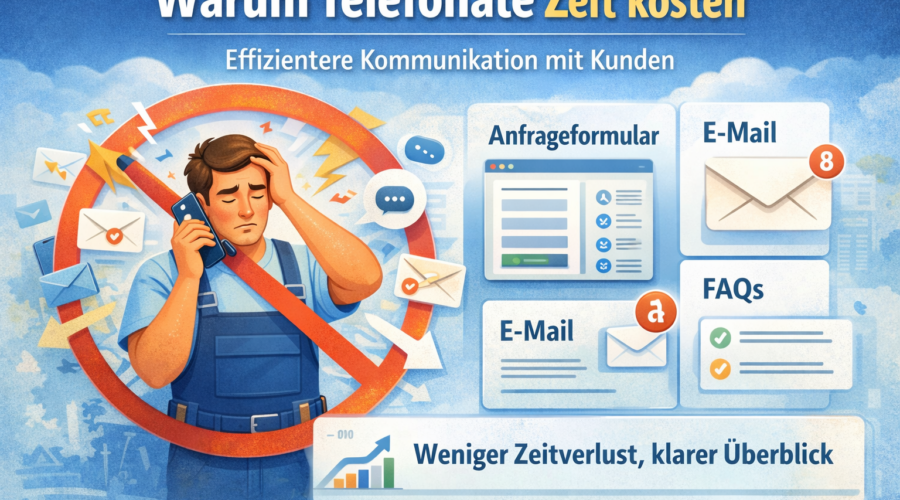
Why do phone calls cost time?
How service providers can organize their communication more efficiently
Many service providers believe that telephone calls are the fastest way to communicate with customers. In reality, however, they often cost a lot of time and do not always lead to better results. During a phone call, both parties need to be available at the same time, information is sometimes forgotten or incompletely passed on, and important details are quickly lost.
The telephone can become a real time trap, especially when there are many daily inquiries.
The problem with spontaneous phone calls
A typical phone call often begins without preparation. The customer calls and spontaneously explains their request. Important information such as the exact address, desired appointment or details about the service are often missing.
This means that the service provider has to ask a lot of questions. Sometimes a conversation takes several minutes, even though the same information could be conveyed in a few lines in writing.
If several customers call in one day, this time expenditure adds up considerably.
Phone calls interrupt work
Another disadvantage is that phone calls often take place in the middle of work. A tradesman is working on a construction site, a service provider is on the road or concentrating on a task.
A call forces him to interrupt his work. After that, it often takes a few minutes to get back into the flow of work.
These small interruptions can make the entire working day less efficient.
Written requests are often clearer
Many service providers are finding that written inquiries are much more structured. Customers can send their request via a form or message and provide important information directly.
For example:
Name and contact
Place of service
Description of the problem
Desired date
With this information, the service provider can decide immediately whether and how they can help.
More overview with multiple customers
When requests are received in writing, they remain documented. The service provider can read, sort or prioritize them again later.
Phone calls, on the other hand, often disappear into memory. Without notes, important details can be lost.
Structured communication therefore ensures a better overview and fewer misunderstandings.
Telephone remains important – but targeted
This does not mean that telephone calls are bad in principle. They are particularly useful when an order is already concrete or when quick coordination is required.
For initial inquiries, however, a written request is often the more efficient way.
Conclusion
Phone calls are still part of the communication between customers and service providers. Nevertheless, too many spontaneous calls can cost a lot of time and disrupt the workflow.
A combination of structured online inquiries and targeted telephone calls helps to save time and at the same time respond professionally to customer inquiries.
This leaves more time for what really counts: good work and satisfied customers.