Contact form in the advertisement – when is it useful?
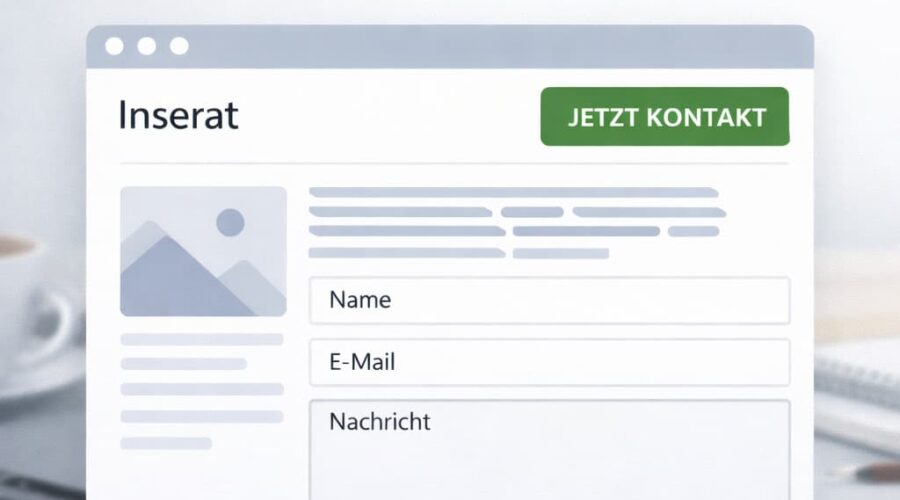
A contact form has been a standard feature of many online advertisements for years.
But is it really always the best solution today?
Or are there situations in which a different contact model works better?
The answer is: It depends on the advertisement, the offer and the target group.
When a contact form in the advertisement makes sense
A contact form makes sense if:
- 📋 structured information is required
- 🧾 Requests should be comparable
- 🕒 delayed processing is sufficient
- 🏢 these are formal requests
Typical examples:
- Real estate listings
- B2B services
- Requests for quotation with multiple details
- Applications or project inquiries
Here a form helps to request important information from the outset
(e.g. budget, time period, requirements).
When a contact form is more of a hindrance
In many cases, however, a contact form acts as a deterrent.
It becomes problematic when:
- too many mandatory fields are present
- the user does not know whether he will receive an answer
- the request is actually very simple
Especially for:
- local services
- Classifieds
- simple offers
companies lose inquiries unnecessarily due to forms.
Many users cancel the contact before they even send it.
User behavior: short, fast, direct
The reality is simple:
users don’t want any hassle, especially for small or spontaneous requests.
Instead of filling out a form, they would rather write:
“Hello, is the offer still available?”
The lower the hurdle, the higher the request rate.
The right decision: Form or direct contact?
The best solution is often not either – or, but situational.
Contact form useful for:
- complex services
- Offers requiring explanation
- professional B2B inquiries
Direct contact makes sense for:
- quick queries
- local advertisements
- Services with a personal touch
A good advertisement offers the user a clear, simple contact option,
adapted to the purpose of the offer.
Conclusion
A contact form in the advertisement is not a mistake – but
is also not a universal solution.
Companies should ask themselves:
- What information do I really need?
- How quickly should contact be established?
- How high is the inhibition threshold for the user?
If you adapt the contact channel to the advertisement,
receives more inquiries and better conversations.