
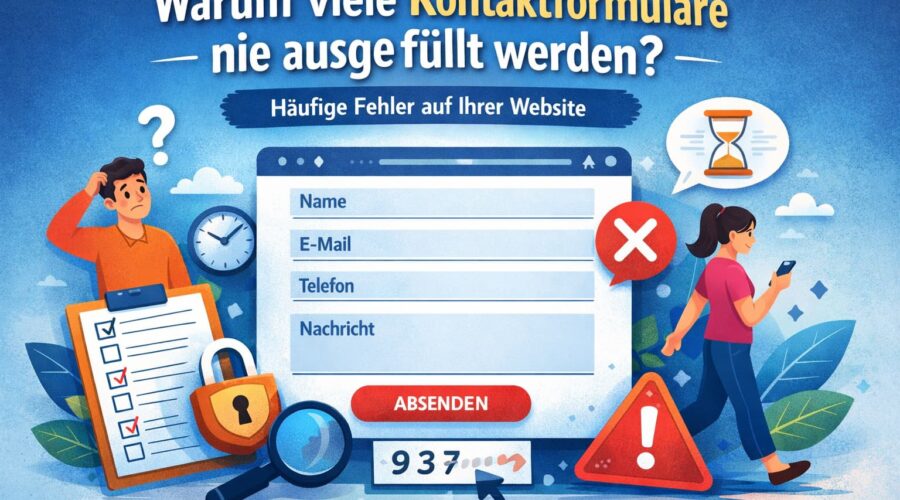
Why many contact forms are never filled out?
Many companies wonder why visitors visit their website but don’t fill out a contact form. The page is visible, the offers are visible – and yet no inquiry is received.
The problem is often not with the offer, but with small details on the website. Just a few obstacles can cause visitors to break off contact.
Too many fields in the form
A common mistake is contact forms that are too long. If visitors have to enter a lot of data, they quickly lose motivation.
Typical fields such as name, e-mail and message are sufficient in most cases. Each additional field increases the likelihood that a visitor will leave the form.
A simple form is faster, friendlier and lowers the inhibition threshold for an inquiry.
Unclear expectations for the visitor
Many contact forms do not explain what happens after the form is sent. Visitors ask themselves, for example:
- When will I get an answer
- Will my request be taken seriously
- Does anyone really get back to me
A short piece of information such as
“We usually reply within 24 hours”
can already create trust.
Too much mistrust due to complicated security queries
Spam protection is important. But if visitors first have to solve several complicated captchas, this can be a deterrent.
A simple security field or reCAPTCHA is often sufficient without overwhelming the visitor.
Poor visibility of the form
Sometimes the form is available but too difficult to find. Visitors have to scroll or search for a long time.
A good contact form should:
- be clearly visible
- be quickly accessible
- work smoothly on mobile devices
Many successful websites place the form directly at the top of the page or at the end of an offer.
No clear reason to make contact
Visitors often need an incentive to make an inquiry. If the website only shows information but does not offer a clear next step, often nothing happens.
Examples of clear calls to action are
- Enquire now without obligation
- Receive a free quote
- Request advice
Such hints help the visitor to understand what he can do next.
Lack of trust
If a website contains little information about the company, many visitors are reluctant to enter their details.
Helpful are for example:
- Real contact details
- Address or location
- Reviews or references
These elements show that there is a real company behind the website.
Conclusion
If a contact form is rarely used, the problem is rarely due to visitor interest. It is often due to small obstacles such as too many fields, unclear processes or a lack of trust.
If you make your form simple, visible and easy to understand, you significantly increase the chance that visitors will actually make contact.
A good website makes it easy for the user to take the next step – and this is often what decides whether a visitor becomes a customer.